.png)
Are Schools Preparing Students for the Workforce of Tomorrow, or the Workforce of Yesterday?
- Jun 7
- 8 min read
Lately, we've found ourselves here at EduShift diving deeply into workforce reports, future trends research and industry forecasts. Not because we are interested in predicting the future. But because we are interested in a much more important question.
What does the world need from young people leaving school today?
If schools exist to prepare young people for life beyond the school gate, then understanding the changing nature of work, society and human capability feels like a worthwhile place to start. Too often, however, educational conversations remain trapped within educational circles. We debate curriculum, assessment and pedagogy while rarely stepping back to ask a more fundamental question:
What are employers, industries and organisations actually telling us they need from the next generation?

Recently, we explored Udemy's 2026 Global Learning & Skills Trends Report. Drawing on learning data from more than 17,000 organisations globally, the report provides a fascinating snapshot of where workforce development is heading. What struck us most was not the report's focus on artificial intelligence, but the consistent message emerging beneath it. Organisations are increasingly investing in adaptability, communication, critical thinking, leadership, collaboration, judgement and continuous learning. The World Economic Forum's Future of Jobs Report reaches a remarkably similar conclusion, identifying analytical thinking, resilience, flexibility, leadership and creativity among the fastest-growing capabilities required in the modern workforce.
As we read these reports, we found ourselves returning to the same question:
Are schools preparing students for the workforce that is emerging, or the workforce that existed yesterday?
The more reports we read, the more we realised this is no longer a conversation about future trends. These capabilities are not predictions about what employers might value in ten years' time. They are capabilities organisations are investing in right now because they are struggling to find them right now.
In many ways, the future of work has already arrived.
The question is whether schooling has noticed.
Schools Are Still Debating Yesterday's Questions
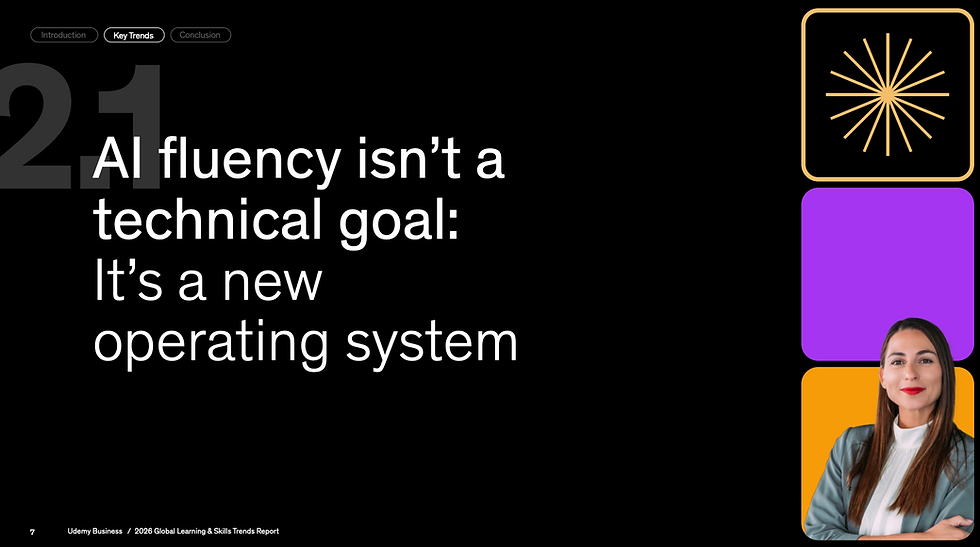
One of the most significant findings from the Udemy report is the shift from AI skills to AI fluency. The distinction matters because organisations are no longer asking whether employees should use AI. They are asking how employees can use AI effectively, ethically and critically. In many workplaces, AI is no longer viewed as an emerging technology that may arrive one day. It has already arrived, and organisations are investing heavily in helping people learn how to work alongside it.
Yet in schools, much of the conversation remains focused on whether students should use AI at all.
Should they use it for assignments?
Should they use it for research?
Is it cheating?
How do we stop it?
These are understandable questions. However, they reveal something deeper. While many schools are still debating whether students should use AI, organisations across the globe are investing heavily in helping employees work alongside it. They are developing AI capability frameworks, redesigning workflows and training staff to combine human judgement with machine intelligence.
The workforce is not preparing for a future where AI might become important.
It is responding to a present in which it already is.
This creates a growing risk for education. By the time schools reach consensus on whether AI belongs in classrooms, the workplace may already have moved several steps ahead. The conversation is no longer about access. It is about fluency.
More broadly, AI forces us to confront a difficult question about the purpose of school itself. For generations, schools have largely been organised around access to knowledge. Teachers held information, students received information and success often depended on how effectively students could acquire and reproduce that information. But information is no longer scarce. The challenge facing young people is not finding information. The challenge is making sense of it, evaluating its quality, identifying bias, applying it in meaningful ways and using it to solve increasingly complex problems.
The tools have changed.
The structure, in many places, has not.
The Capabilities Contradiction
Most schools already know that capabilities matter. Walk through almost any school and you will find references to critical thinking, collaboration, creativity, communication and adaptability. They appear in strategic plans, learner profiles, websites and prospectuses because educators understand that these capabilities are important.
The challenge is not that schools value the wrong things.
The challenge is that many of the structures students experience every day were never designed to develop those capabilities in the first place.
Schools often find themselves caught in an uncomfortable contradiction. We say we value collaboration, yet most assessment remains individual. We say we value creativity, yet many learning experiences still reward conformity. We say we value critical thinking, yet students are frequently rewarded for reproducing expected responses. We say we value adaptability, yet entire year levels are expected to move through learning at the same pace regardless of readiness.
In other words, we often claim to value one thing while our structures reward another.
The issue is not that educators lack awareness. The issue is that many of the structures underpinning modern schooling were designed to achieve different outcomes.
A timetable divided into six one-hour subject blocks was not designed to develop systems thinking. A curriculum organised into isolated disciplines was not designed to help learners tackle complex real-world challenges. Assessment structures built around individual performance were not designed to cultivate collaboration. Age-based progression was not designed to accommodate vastly different rates of learning.
These structures made sense for a different era and a different purpose. They helped standardise learning, manage large cohorts and ensure broad curriculum coverage. The problem is that the outcomes increasingly demanded by the workforce are often at odds with the structures we continue to use.
That's not a teacher problem.
It's a design problem.
Knowledge Matters. But It Is No Longer the Destination.
Whenever conversations like this emerge, a false dichotomy usually follows. Some people assume the argument is that knowledge no longer matters. Others assume that capabilities are somehow replacing academic rigour.
Neither is true.
The workforce is not asking schools to teach less knowledge.
It is asking schools to rethink the role knowledge plays.
The challenge is not that schools teach knowledge. The challenge is that knowledge has become the organising principle of schooling. Subjects are organised around content. Timetables are organised around content. Assessment is organised around content. Success is often measured by how effectively students acquire content.
Yet the modern workplace rarely rewards people for what they know in isolation.
It rewards what they can do with what they know.
Imagine a student investigating how their community could reduce food insecurity. To contribute meaningfully, they would need knowledge of biology, economics, statistics, ethics and communication. They would need to analyse data, evaluate evidence, engage with stakeholders and communicate recommendations. The knowledge remains essential, but it serves a larger purpose.
The knowledge serves the problem.
The problem does not serve the knowledge.
Yet much of schooling remains organised as though knowledge itself is the end point. Students move from topic to topic, unit to unit and assessment to assessment, often with little opportunity to apply their learning in authentic and meaningful contexts. This creates a significant disconnect.
The workforce is increasingly asking people to solve complex problems using knowledge drawn from multiple disciplines. Schooling often asks students to acquire knowledge within disciplines and hope they eventually connect it for themselves.
One develops capability.
The other develops coverage.
This is perhaps the most significant challenge facing schools today.
The workforce is increasingly asking people to navigate complexity. Schooling is often organised around simplicity. The workforce rewards people for connecting ideas across disciplines. Schooling frequently separates those disciplines into different classrooms, different teachers and different timetable blocks.
One model prepares learners to navigate complexity. The other prepares learners to navigate subjects. Those are not the same thing. The world is becoming increasingly interconnected. Learning often remains fragmented.
The Curriculum Isn't the Barrier. Our Interpretation Is.
Workforce reports consistently highlight adaptability, self-direction and continuous learning as essential capabilities for success. Increasingly, organisations need people who can identify what they need to learn, access resources independently, seek feedback and continuously develop new capabilities as industries evolve.
In other words, they need learners.
Yet many students spend thirteen years in systems where almost every aspect of learning is predetermined. What they learn, when they learn it, how long they spend on it, how they demonstrate it and what success looks like are often decided long before they enter the classroom.
Consider two students sitting side by side. One has already mastered the concepts being taught and is eager to move further, deeper and faster. The other requires additional time, support and feedback before they are ready to progress. Yet both are frequently expected to move through the curriculum according to the same timeline because the timetable, the year level structure and the assessment schedule demand it.
For one student, this creates boredom.
For another, anxiety.
For both, it raises an important question.
If we know learners develop at different rates, why do we continue to organise learning as though they do not?
Too often, schools respond by pointing to curriculum requirements, reporting obligations or system constraints. Yet there are schools across Australia and around the world demonstrating that greater flexibility, greater agency and greater personalisation are entirely possible within existing frameworks. The curriculum is rarely the barrier.
More often, it is our interpretation of what schooling must look like.
The Australian Curriculum tells us what students should learn. It does not prescribe six isolated subjects each day. It does not require every learner to move at the same pace. It does not demand rigid timetables, age-based progression or fragmented learning experiences. Yet many schools continue to treat these structures as though they are requirements rather than design choices.
They are not requirements.
They are choices.
And every choice should be open to reconsideration if it no longer serves the outcomes we claim to value. Many schools have become exceptionally good at delivering the curriculum. The question is whether curriculum delivery alone is enough to prepare young people for the world they are entering.
Time Is Running Out
There was a time when schools could afford to move slowly. The world changed gradually, industries evolved over decades and educational systems could respond at a similar pace.
That is no longer the world we inhabit.

Artificial intelligence is reshaping industries in real time. Organisations are redesigning roles, redefining capability frameworks and investing heavily in skills that barely featured in workforce conversations five years ago. Meanwhile, many schools remain locked in debates about structures that have changed little in generations.
The risk is not that schools fail to predict the future correctly.
The risk is that by the time change arrives in schools, it has already happened everywhere else.
And for today's students, that delay matters.
The workforce has already changed.
The question is whether schooling is willing to change with it.
At EduShift, these are the conversations we are having with schools every day. Not because we have all the answers, but because we believe the questions matter.
How do we create learning experiences that develop adaptability rather than compliance?
How do we design structures that support agency rather than constrain it?
How do we move beyond curriculum coverage and towards genuine capability development?
How do we ensure students leave school prepared for the world they are entering, rather than the world that existed when the system was designed?
Because preparing young people for tomorrow requires more than adding new programs to yesterday's model.
It requires the courage to rethink the model itself.
If this article has sparked questions about your own context, we'd love to continue the conversation.


Comments